
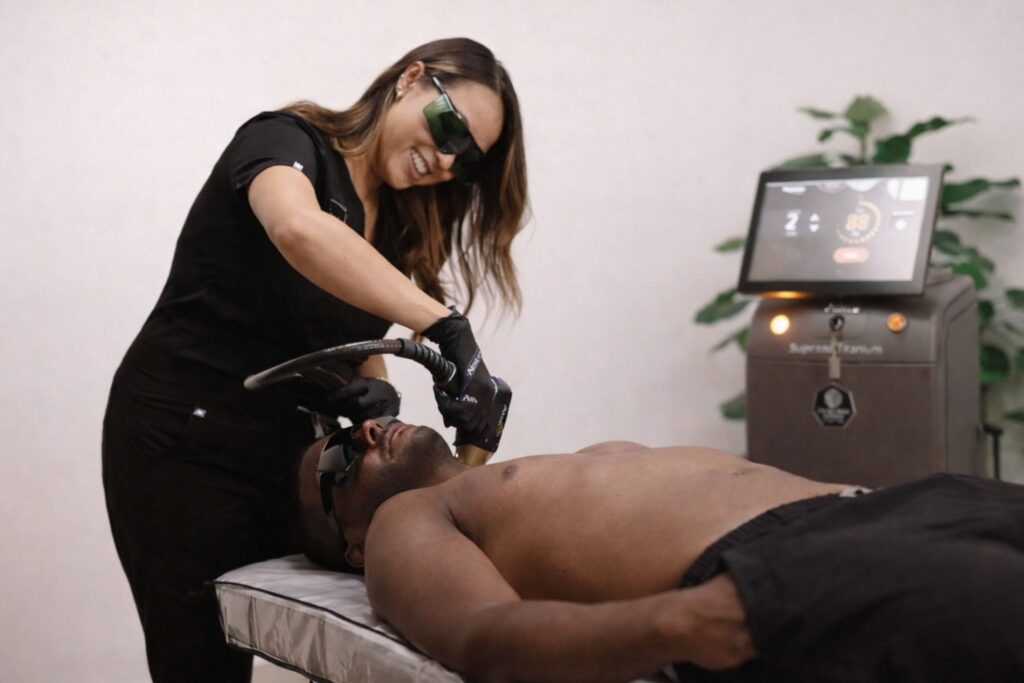
Let’s answer the real question first. Laser hair removal for dark skin works, works safely, and works beautifully, with one qualifier that this entire article exists to explain: the device matters. Not somewhat, not as a nice-to-have, but as the single biggest factor separating a great experience from the stories that made deeper skin tones cautious about laser in the first place. Every laser hair removal appointment in Tampa at NÜDE runs on that device standard.
At NÜDE Laser Hair Removal & Aesthetics in Tampa, every treatment runs on a system built for all skin tones from the ground up. Here’s the honest history, the wavelength that changed the answer, and what to look for anywhere you book.
Why Dark Skin Was Ever a Question
Laser hair removal works by aiming light energy at melanin, the pigment in hair. The laser heats the dark pigment, the heat travels down the shaft, and the follicle stops producing. Simple physics, with one complication: melanin isn’t only in hair.
Skin has melanin too, and deeper complexions have more of it. Early single-wavelength lasers couldn’t reliably tell the difference between pigment in the hair and pigment in the skin around it, so on darker skin tones, energy meant for the follicle could land on the surface instead. That’s where the old cautions about burns and dark spots came from, and why a generation of providers turned away clients with deeper complexions.
Those stories were about equipment limitations, not about skin. The physics never said dark skin couldn’t be treated. It said the machine had to be smarter about where its energy went.
In a city as diverse as Tampa, that equipment gap left a lot of people underserved for a lot of years. Clients still arrive at consultations carrying a decade-old warning from a friend or a forum, and the most satisfying part of the conversation is explaining how completely the technology has moved on.
The Wavelength That Changed the Answer
Enter the Nd:YAG, the wavelength measured at 1064 nanometers. If one piece of technology deserves credit for opening laser hair removal to every skin tone, it’s this one.
The 1064nm wavelength absorbs far less melanin than older hair removal wavelengths. In practice, that means its energy passes the skin’s surface pigment without grabbing onto it, travels deeper, and does its work at the follicle. The surface stays calm; the follicle gets treated. Nd yag laser hair removal became the standard answer for deeper complexions for exactly this reason.
The 810nm diode wavelength backs it up with a moderate absorption profile that stays safe across a wide range of skin tones. Between the two, the guesswork that made old-generation treatments risky on melanin-rich skin simply isn’t part of the equation anymore.
What the Soprano Titanium Does Differently
Plenty of clinics own an Nd:YAG. The Soprano Titanium by Alma goes further by firing three wavelengths, 755nm, 810nm, and 1064nm, simultaneously in a single pass, so every session works multiple follicle depths at once while staying calibrated to your skin tone.
The system is cleared for all Fitzpatrick skin types, I through VI, which is the full human range from the fairest to the deepest. Your provider sets the treatment to your skin at every visit, not from a preset chart, and the in-motion technique with continuous cooling keeps sessions comfortable. Most clients compare the feeling to a warm stone massage.
And because the system needs no downtime and no extended sun avoidance, the calibration conversation is the only extra step. You’re back to your Tampa day the moment your session ends.
There’s a quiet advantage worth naming too. Laser targets pigment, and dark, coarse hair carries the most pigment of all, which makes it the clearest possible target. Once the skin-tone question is solved by the wavelength, deeper complexions with dark hair are among the best candidates this treatment has.
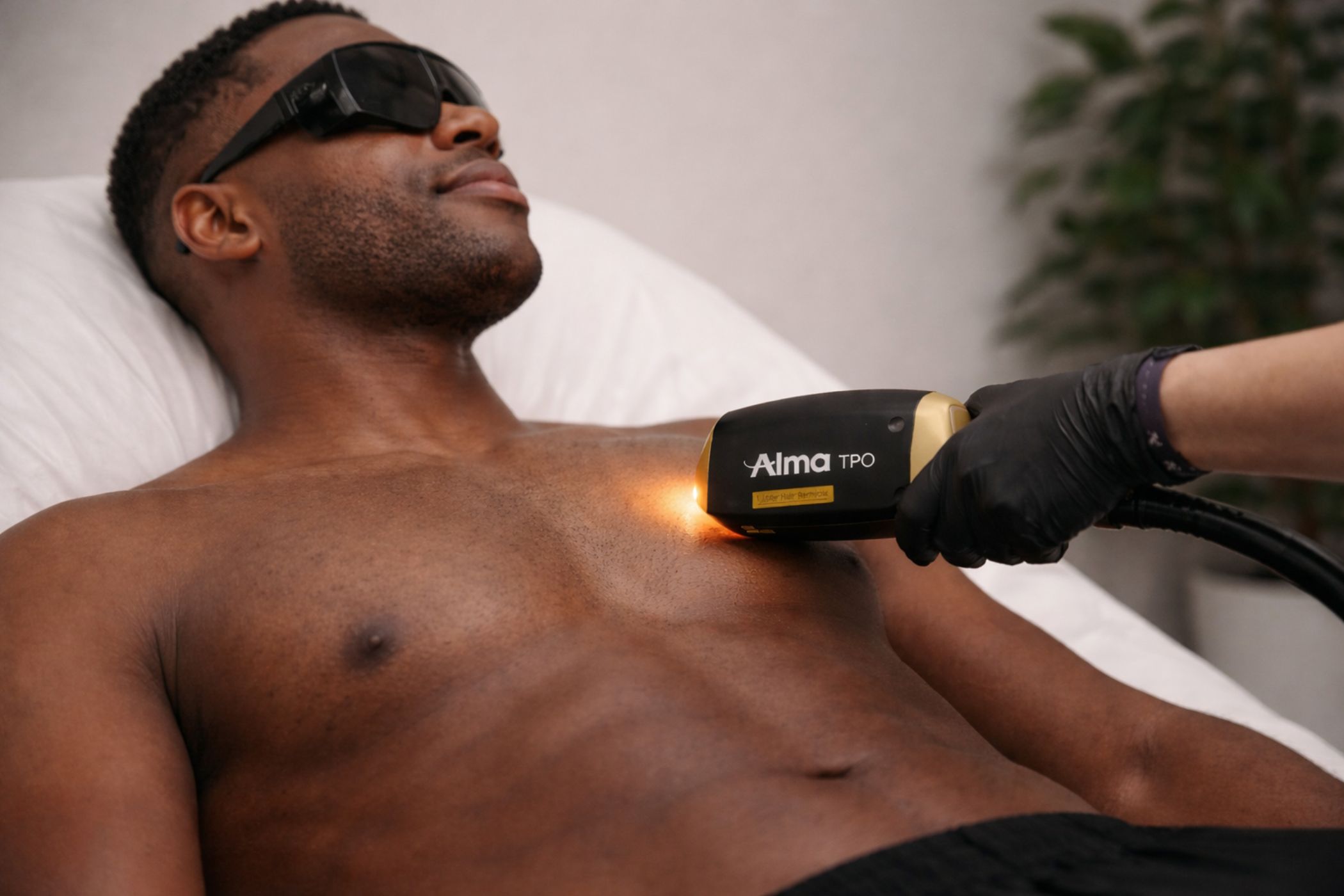
Is Laser Hair Removal Safe for Dark Skin?
Yes, with the right device in trained hands, and that combination is the checklist. Safe treatment on melanin-rich skin is a solved problem where three things are true: the machine carries a low-absorption wavelength like the 1064nm, the provider assesses your skin in person before treating it, and the settings are calibrated to you rather than to an average.
That’s also your shopping guide if you’re comparing providers. The best device for deeper skin tones is one built for them, not adapted to them, so ask any clinic directly: What system do you use? Which wavelengths does it carry? Is it cleared for my skin type? A provider who answers those three questions specifically and confidently is a provider worth your consultation.
The red flags are just as clear. Hedged answers about skin tone, a single-wavelength system with no Nd:YAG, or a booking process that skips the consultation entirely are all signs to keep looking. Your skin deserves a provider who can explain their equipment, not one who asks you to take it on faith.
Laser hair removal for black skin deserves the same directness: the coarse, curly hair types most prone to razor bumps and ingrown hairs respond especially well to treatment, and the follicle-reduction approach calms those patterns at the source. The population that old equipment served worst is the one modern equipment serves best.
What to Expect at NÜDE
Every plan starts with a consultation. Your provider looks at your skin, your hair, and your zones, answers the wavelength questions before you ask them, and builds a per-zone plan with settings chosen for your skin tone specifically. Bring every question this article raised; providers who work on the right equipment enjoy answering them.
From there, the plan runs like anyone’s: most clients need 8 to 12 sessions spaced 6 weeks apart, extending to every 8 weeks as growth slows, with maintenance touch-ups 2 to 4 times a year afterward. Every zone on the menu is available, from upper lip to full body, at the same pace and pricing as every other skin tone.
The studio’s own Google reviews tell the story better than any article can, including clients with deeper skin tones who arrived nervous about whether laser was made for them and left recommending it. That relief is the review theme we’re proudest of.
Frequently Asked Questions
Is laser hair removal safe for melanin-rich skin?
Yes, on the right equipment with a real consultation first. The 1064nm Nd:YAG wavelength was made for exactly this, absorbing less melanin so energy reaches the follicle without overloading surface pigment. Confirm the device and the skin-type clearance with any provider you consider, and you’ve handled the safety question.
Does it hurt more on darker skin?
No. With settings calibrated to your skin tone and cooling running the whole session, comfort doesn’t divide by complexion. The Soprano Titanium’s gradual in-motion warmth reads as heat rather than sting, and the warm stone massage comparison comes from clients across every skin tone.
Which laser is best for dark skin?
Systems carrying the Nd:YAG 1064nm wavelength are the established answer, and multi-wavelength platforms like the Soprano Titanium add the 810nm’s coverage on top. If a device carries only older, high-absorption wavelengths, it wasn’t built with deeper complexions in mind, and that’s worth knowing before you book anywhere.
Can the deepest skin tones be treated?
Yes. The Soprano Titanium is cleared for all Fitzpatrick skin types, I through VI, which covers the complete range of human skin tones. Your consultation confirms the right settings for your skin specifically, and your provider recalibrates at every visit.
Does laser cause dark spots on dark skin?
That risk belongs to the old-equipment era and to improper settings, which is why device choice and a real consultation matter so much. Proper calibration on a low-absorption wavelength exists precisely to keep surface pigment out of the equation. If you have any pigmentation concerns about your skin, raise them at your consultation, and anything needing a medical opinion goes to your dermatologist first.
How many sessions will I need?
The same series as every skin tone: most clients need 8 to 12 sessions spaced 6 weeks apart, with maintenance touch-ups 2 to 4 times a year after the series. Skin tone changes the settings, never the count, and coarse hair often shows progress fastest.
Next Steps for Every Skin Tone
If deeper skin has kept you on the sidelines of laser, the technology conversation is over and your side won:
- Ask any provider the three device questions: what system, which wavelengths, cleared for whom
- Book a consultation and have your skin assessed in person, never over the phone
- Expect calibration at every visit, not a one-time setting
Ready for answers about your skin specifically? Book a free consultation with NÜDE Laser Hair Removal & Aesthetics, or browse the full lineup of laser hair removal in Tampa services to see every zone we treat.
