
Here’s a question that deserves a straight answer instead of a sales pitch: does laser hair removal work on blonde hair? Sometimes, genuinely. On red hair? Less often, honestly. On gray or white hair? No, and anyone telling you otherwise is selling something.
The reason is physics, not policy, and it’s worth two minutes to understand, because it also points to what actually works when laser isn’t your answer. Here’s the whole picture, color by color.
Why Hair Color Decides
Laser hair removal works by aiming light energy at melanin, the dark pigment in hair. The laser heats the pigment, the heat travels down to the follicle, and the follicle stops producing. Dark hair is full of melanin, which makes it a clear target. The lighter the hair, the less pigment there is to heat, and the less the laser has to work with.
That single fact explains every answer in this article. It’s not about your skin, your zones, or your provider’s skill. It’s about whether your hair carries enough pigment to catch the light.
It’s also why hair color never mattered to your razor or your wax strips. Those methods grab the hair physically, color-blind and indifferent. Laser traded that indifference for something better, treating the follicle itself, and the price of the trade is that it needs pigment to find its way there.
Blonde Hair: The It-Depends Answer
Blonde covers a lot of territory, and candidacy follows the shade. Dark blonde and dirty blonde hair usually carries enough melanin to treat, especially on a system built for it. Platinum and very light blonde sits at the other end, where pigment runs too thin for reliable results.
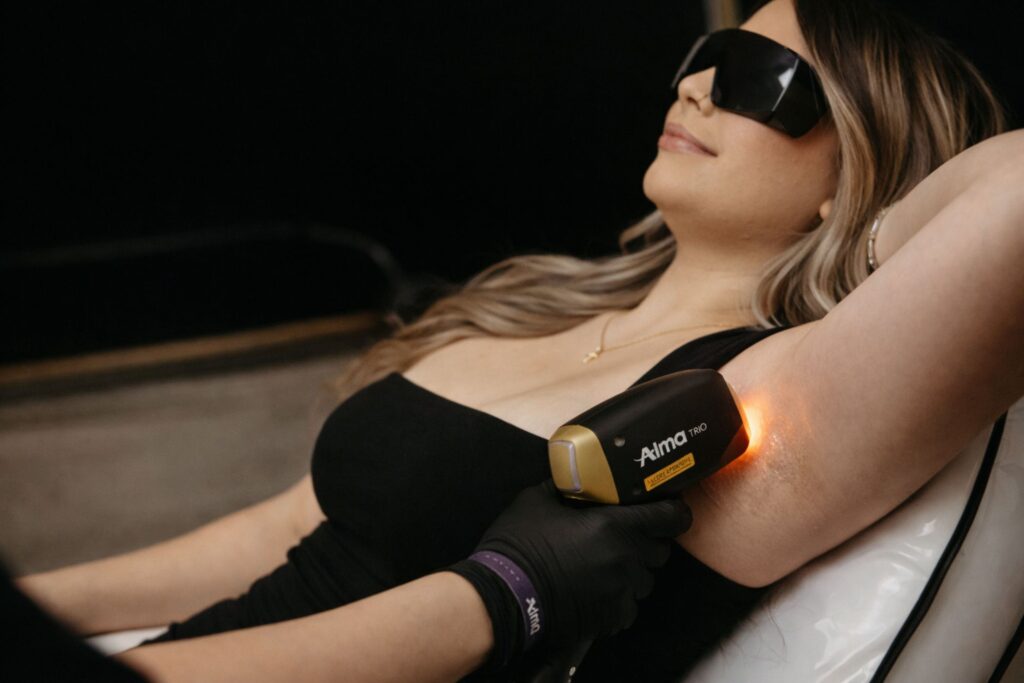
Equipment moves the line further than most people expect. The Soprano Titanium’s 755nm alexandrite wavelength absorbs melanin strongly, and Alma positions it specifically for light-colored and fine hair, which makes laser hair removal blonde hair candidates out of people who were turned away a decade ago.
One nuance sun-state blondes should know: what matters is the color at the root, not the sun-lightened lengths. Florida hair often reads two shades lighter at the ends than at the follicle, and the follicle is where the laser does its work. Plenty of clients who look platinum in July are treatable dark blondes underneath.
The deciding vote belongs to a test pass at your consultation, not to an article. If your blonde reads as treatable, you’ll see the response; if it doesn’t, you’ll hear that plainly and save your money.
Red Hair: The Honest Odds
Red hair runs on a different pigment. Instead of the dark eumelanin the laser targets, red hair carries pheomelanin, a lighter, warmer pigment that absorbs laser energy poorly. That’s why the traditional answer for laser hair removal red hair was a flat no.
The modern answer is more nuanced but still honest: deeper auburn and red-brown shades carry some eumelanin and can respond, while true copper and strawberry shades usually don’t carry enough to treat reliably. A consultation with a test spot tells you which side of the line your hair sits on.
What we won’t do is promise a redhead a full series and let the results explain themselves. If the test pass doesn’t respond, you’ll know before you’ve spent anything but an hour.
Gray or White Hair: The Straight Answer
No. Gray and white hair has lost its melanin entirely, which means there’s nothing in the shaft for the laser to heat. No wavelength, no setting, and no machine changes that, including ours.
This is worth saying clearly because laser hair removal gray hair searches attract a lot of soft answers and a few dishonest ones. A provider who treats pigment-free hair is collecting session fees for physics that can’t happen. The trustworthy version of this conversation is short: laser isn’t your tool, and here’s what is.
Electrolysis vs Laser Hair Removal: When the Other Tool Wins
Electrolysis treats one follicle at a time with a fine probe and a tiny electrical current, and it has one property laser can never match: it doesn’t care about color. Pigment-free gray, white, platinum, and true red hair all respond, because the method works on the follicle directly instead of targeting pigment.
The trade-offs run the other way too. Electrolysis is slower, treating hair by hair where laser covers whole zones in minutes, which makes it best suited to smaller areas and finishing work. The American Academy of Dermatology’s hair removal guidance covers both methods, and the practical split lands simply: pigmented hair over large areas favors laser, and pigment-free hair or stray finishing favors electrolysis.
In the electrolysis vs laser hair removal decision, the winner is whichever matches your hair, and a studio that tells you that plainly is a studio you can trust with the rest of your questions.
What a Consultation Settles
Most real heads of hair are mixed, which is where consultations earn their keep. The most common version: mostly dark hair with early grays scattered through. The plan there is straightforward, laser the pigmented majority now, and handle the stray grays with electrolysis later if they bother you.
A consultation at NÜDE looks at your actual hair in your actual zones, runs a test pass where candidacy is uncertain, and gives you the answer the physics supports. If that answer is yes, the plan follows the standard series: most clients need 8 to 12 sessions spaced 6 weeks apart, extending to every 8 weeks as growth slows, with maintenance touch-ups 2 to 4 times a year.
Bring nothing but unshaved growth in the zone you’re asking about, since your provider needs to see the hair to read it. Photos of your hair in different light help with borderline shades, and so does knowing your natural root color if you dye.
And if the answer is no, you’ll get it in one appointment instead of after a paid series. That policy costs us the occasional booking and earns the kind of Google reviews that mention honesty by name.
Frequently Asked Questions
Does laser work on blonde hair?
Often, when the blonde runs dark enough to carry real pigment. Dark and dirty blondes are frequently good candidates, especially on the 755nm alexandrite wavelength, while platinum shades usually aren’t. A consultation test pass gives you a per-zone answer instead of a guess.
Does laser work on red hair?
Sometimes, with honest odds attached. Auburn and red-brown shades carrying some dark pigment can respond; true copper and strawberry usually can’t. Ask for a test spot before committing to anything, and treat any provider’s blanket yes with suspicion.
Does laser work on gray or white hair?
No. Gray and white hair carries no melanin, so there’s nothing for any laser to target, at any setting, on any machine. Electrolysis is the method that works regardless of color, and it’s the honest recommendation for pigment-free hair.
What if my hair is mixed, mostly dark with some gray?
You’re likely still a strong laser candidate. The laser treats the pigmented majority, which is usually most of the zone, and the gray strays can be finished with electrolysis afterward if they bother you. Mixed hair is one of the most common consultation conversations we have.
Why can’t any laser treat white hair?
Because the entire mechanism runs on pigment. The laser’s energy converts to heat inside melanin, and white hair has none, so the light passes through without doing its work. It’s a physics limit, not a technology gap waiting for a firmware update.
Can I dye my hair darker so the laser works?
No, and it’s one of the internet’s most persistent workarounds. Dye colors the visible shaft above the skin, but the laser needs pigment inside the follicle, where dye never reaches. Dyed-dark blonde or gray hair reads exactly the same to the laser as it did before the box of color.
Is there a machine that works on gray hair?
No true laser does, and claims otherwise deserve heavy skepticism. Some clinics market workarounds involving dyes or waveband tricks, with results that don’t hold up. For gray hair, electrolysis is the method with the track record, and we’d rather point you there than sell you sessions.
Next Steps for Every Hair Color
Whatever shade you’re working with, the path to a real answer is short:
- Book a consultation and have your actual hair assessed in your actual zones
- Ask for a test pass anywhere candidacy is uncertain
- Expect a straight answer, including the ones that don’t end in a booking
Come find out which answer is yours. Book a free consultation with NÜDE Laser Hair Removal & Aesthetics, or browse the full lineup of laser hair removal in Tampa services to see what a yes looks like.
