
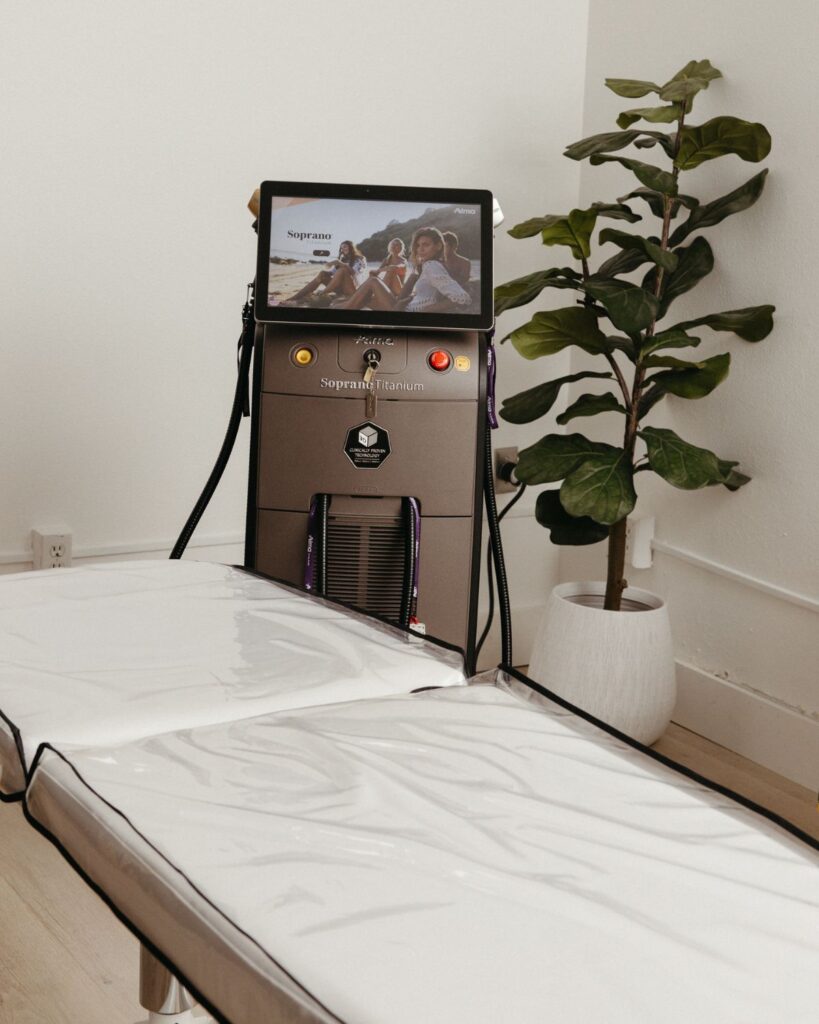
Diode laser hair removal has been around for decades, and if your mental image of a session comes from that era, an update is overdue. What changed can be compressed into one line: one wavelength guessing became three wavelengths firing at once, static zaps became in-motion warmth, and the recovery window shrank to almost nothing. It is the platform behind every laser hair removal in Tampa session at NÜDE.
This post unpacks each of those shifts: how the older systems worked, where IPL fits in the confusion, and what the Soprano Titanium at NÜDE actually does differently. If you researched laser years ago and walked away, consider this the changelog.
The Old Playbook: One Wavelength, One Bet
All types of laser hair removal share the same core move: light energy targets the pigment in hair, heat travels down the shaft, and the follicle stops producing. The differences live in the wavelength, measured in nanometers, and for most of the treatment’s history, every machine carried exactly one. Choosing a clinic meant choosing a wavelength, whether you knew it or not.
The three families that defined the era, each named for the material or method producing its light:
Alexandrite (755nm). The shallow-and-precise option. Alexandrite laser hair removal absorbs melanin strongly, which makes it excellent for finer and lighter hair, and historically risky business on deeper skin tones.
Diode (810nm). The workhorse. Deep follicle penetration, a moderate absorption profile, and the wavelength that made laser hair removal mainstream. Most of the industry’s track record was built on it.
Nd:YAG (1064nm). The deep specialist. Low melanin absorption lets it pass surface pigment safely, which made it the answer for darker skin tones, at the cost of being less efficient on fine, light hair.
Here’s the problem the old playbook couldn’t solve: clinics owned one machine, so your skin tone and hair type had to fit the wavelength they’d bought. If they didn’t fit, you got turned away, treated cautiously, or treated wrong.
Clients from that era remember what it looked like in practice. Numbing cream applied half an hour before a session because everyone knew what static pulses felt like. Consultations that opened with a skin chart to determine whether you were treatable at all. And the sun rules, weeks of avoidance before and after, that made a Florida summer basically off-limits. None of that was bad medicine at the time; it was the technology’s honest ceiling.

What About IPL? (It Isn’t Laser)
Half the ipl vs laser hair removal confusion comes from clinics and devices using the words interchangeably. They’re not the same technology.
A laser emits one coherent wavelength, a single precise frequency of light aimed at one job. IPL, intense pulsed light, fires a broad flash across many wavelengths at once, like the difference between a scalpel and a floodlight. Some of that broad-spectrum energy reaches follicles; much of it scatters into surrounding skin.
IPL is why the at-home device market exists, and for some hair and skin combinations it delivers modest results at a modest price, which in practice means cheaper up front, more sessions later. What it can’t do is match a true laser’s precision, depth, or calibration range, which is why IPL sessions typically run less powerful, results build slower, and deeper skin tones are usually advised away from it entirely.
The at-home version deserves its own expectation-setting. Consumer IPL devices run at a fraction of professional power for safety reasons, which means results arrive slowly, plateau earlier, and vanish faster without constant upkeep. As a supplement between professional series, fine. As a replacement for one, the math rarely works out.
If a provider can’t tell you clearly whether their system is laser or IPL, that’s your answer about the provider.
What the Soprano Titanium Changed
The Soprano Titanium by Alma retired the one-wavelength bet entirely. It fires all three wavelengths, 755nm, 810nm, and 1064nm, simultaneously in a single pass, so every session works multiple follicle depths and hair types at once, calibrated to your skin tone instead of gambling on it.
The delivery method changed just as much. Older systems fired static pulses, one sharp zap at a time over each spot, which is where laser’s painful reputation came from. The Soprano’s SHR technology takes the opposite approach: shr laser hair removal sweeps the applicator in constant motion, building heat gradually while built-in cooling runs the entire session. Clients describe it as a warm stone massage, and the ones who remember old-era sessions say the difference is hard to overstate. Nobody applies numbing cream in the waiting room anymore.
Then there’s the calendar. Older systems came with recovery windows and long sun-avoidance rules that made Florida treatment genuinely awkward. The Soprano Titanium carries minimal to no downtime: you keep sun and tanning off the treated area for 2 to 3 days, wear sunscreen, and get on with your life, year-round.
What It Means for Your Sessions
Technology comparisons only matter where you feel them, and most clients never ask about wavelengths again after their first session. Here’s the translation into things you’ll actually notice:
- Comfort: gradual warmth with constant cooling instead of sharp static pulses
- Eligibility: cleared for all Fitzpatrick skin types, I through VI, so the machine fits you instead of the reverse
- Speed: three wavelengths in one pass and a large applicator make sessions faster, with smaller zones done in minutes
- Scheduling: no recovery window and no season to wait for, which matters in a city with eleven months of sun
The eligibility line deserves one more beat, because it’s the biggest quiet change of all. Under the old playbook, entire groups heard some version of ‘laser isn’t for you’: deeper skin tones, finer hair, anyone mid-tan. The multi-wavelength era retired most of those refusals, and the consultation now exists to calibrate your plan rather than to screen you out.
One thing newer technology doesn’t change: biology. Most clients need 8 to 12 sessions spaced 6 weeks apart, extending to every 8 weeks as growth slows, with maintenance touch-ups 2 to 4 times a year afterward. Hair grows in cycles, and no wavelength count rewrites that. What the machine changes is how those sessions feel and who they’re available to.
Frequently Asked Questions
Is diode the best type of laser for hair removal?
The diode earned its workhorse reputation honestly, but the modern answer is that the best system doesn’t make you choose. Multi-wavelength platforms combine the diode’s depth with the alexandrite’s precision and the Nd:YAG’s safety on deeper tones, which is the whole argument for the newer generation.
What machine does NÜDE use?
The Soprano Titanium by Alma, running all three wavelengths, 755nm, 810nm, and 1064nm, with SHR in-motion delivery and continuous cooling. It’s the only system in the studio, so every zone and every client gets the same technology.
Is IPL as effective as laser?
Not at the professional level. IPL’s broad-spectrum flash trades precision for coverage, which means lower power at the follicle, slower results, and a narrower range of safe skin tones. It has a place in the at-home market; it isn’t what a dedicated laser studio runs.
What is SHR?
Super Hair Removal, Alma’s name for the in-motion technique the Soprano platform uses. Instead of firing sharp single pulses at static spots, the applicator keeps moving and builds heat in the follicles gradually, which is the main reason sessions feel like warmth instead of zaps.
Do older laser systems still work?
Yes, on the right candidate. A single-wavelength machine matched carefully to your hair and skin can absolutely deliver results, and plenty did for years. The honest differences are comfort, speed, and who gets included: older systems work for the clients they happen to fit, and newer platforms fit the client. If you had good results on old equipment, nothing is wrong with them; you’d simply have had an easier time getting them today.
Does newer technology mean fewer sessions?
No, and be wary of anyone promising otherwise. Session count is set by hair growth cycles, not by the machine, so the standard series holds: 8 to 12 sessions spaced 6 weeks apart. What improves with the technology is how comfortable each session is and how consistently every hair type and skin tone can be treated.
Next Steps Past the Old Era
If your picture of laser hair removal was formed years ago, the checklist for updating it is short:
- Ask any provider whether their system is laser or IPL, and which wavelengths it carries
- Look for multi-wavelength platforms if your skin tone or hair type ever got you turned away
- Book a consultation and feel the in-motion difference on a test pass
Ready to see what changed in person? Book a free consultation with NÜDE Laser Hair Removal & Aesthetics, or browse the full lineup of laser hair removal in Tampa services running on the Soprano Titanium.
